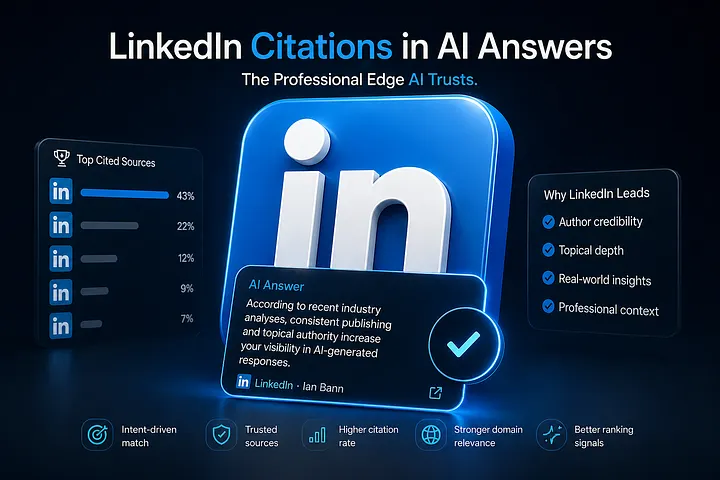
Most people are looking at AI visibility the wrong way. They look at what content shows up and try to copy it, but that only gets you so far. The recent study by Semrush makes this clear, especially with how often LinkedIn appears inside AI-generated answers.
The part that’s easy to miss is why that keeps happening. AI systems are not picking content because it’s popular or because it lives on a certain platform. They are picking content that they can understand quickly and reuse without getting it wrong, and that changes how visibility actually works.
AI visibility is determined by how easily your content can be extracted, understood, and reused inside AI-generated answers.
If you want a practical model for this, use the AI Visibility Framework as your operational baseline.
Why LinkedIn Appears Frequently Inside AI-Generated Answers
AI systems select LinkedIn content because it reduces uncertainty during answer construction. This happens because LinkedIn content usually includes clear identity, role, and topic alignment signals. When those signals are present, the system can assign higher confidence during retrieval and use the content more easily.
AI-generated answers are not built from “top-ranked pages,” and that’s where a lot of people still get stuck. The system is trying to build something usable from pieces of content it trusts, and that usually means content it can understand quickly without guessing too much. That’s where platforms like LinkedIn come in.
Tools like ChatGPT and Perplexity AI keep pulling from LinkedIn, and the Semrush study shows this pretty clearly in the data. But the important part is not the percentage, it’s why that keeps happening.
LinkedIn content usually makes it obvious who is speaking, what they do, and how that connects to the topic. That reduces uncertainty for the system, and when uncertainty drops, selection goes up.
If that clarity is missing, even good content can get skipped because the system can’t confidently place it.
How AI Systems Extract and Reuse LinkedIn Content
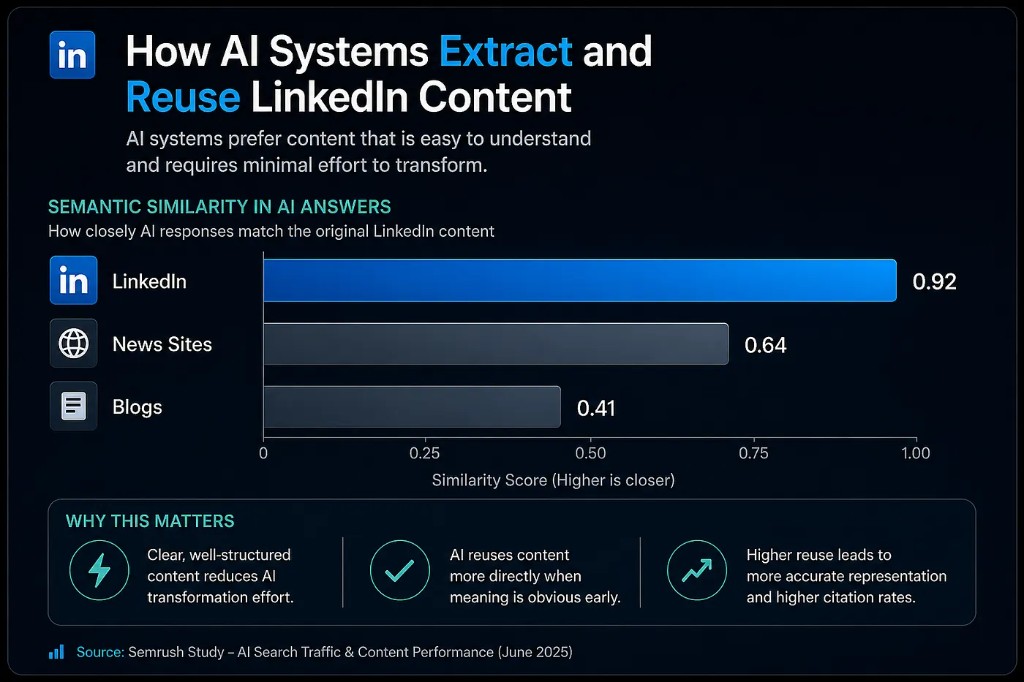
AI systems reuse LinkedIn content when it lowers transformation effort during answer generation. This means content that already explains something clearly is more likely to be selected. When the system does not need to rewrite or interpret heavily, it can use the content directly.
There’s a stat in the study about semantic similarity that looks interesting on the surface. AI responses often stay quite close to the original LinkedIn content, and this happens because the system is always trying to do less work, not more.
If it finds a piece of content that already explains something cleanly, it just uses it. It doesn’t try to rewrite it unless it has to. So when a post defines something properly in the first few lines, the system can lift that meaning almost as-is, which keeps the output stable.
That creates a pattern. Content that is clear early tends to show up more, and when it does show up, it tends to be represented more accurately. Content that takes time to get to the point often gets reshaped or ignored, and sometimes both.
Why Content Structure Affects AI Visibility Outcomes
Content structure determines how easily AI systems can extract and trust information. Clear structure reduces the need for interpretation during retrieval. When interpretation is reduced, selection becomes more likely.
Structure sounds like a boring topic, but it ends up being one of the main reasons content either shows up or disappears. When a piece of content introduces a concept clearly and sticks to consistent language, the system can treat it like a stable reference without needing to reinterpret it.
If the structure is loose or the wording keeps shifting, the system has to interpret more, and that increases uncertainty. When uncertainty increases, the chances of that content being used drop. It’s not always obvious when this is happening, which is why people think their content should be visible when it isn’t.
How Long-Form and Short-Form Content Serve Different Roles
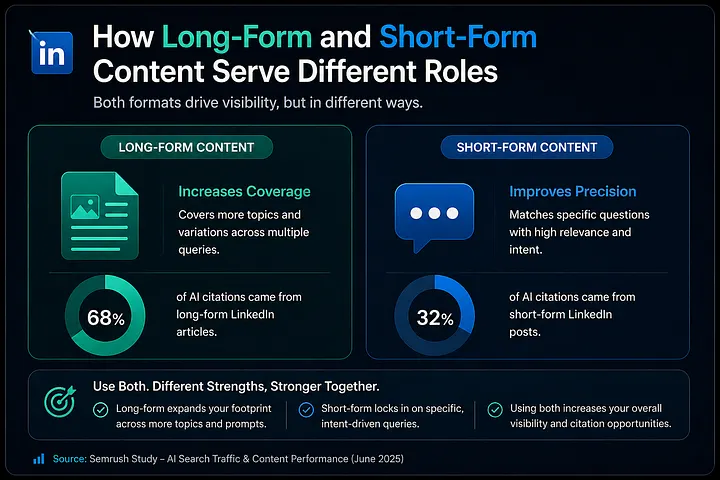
Long-form content increases coverage across queries, while short-form content improves precision for specific prompts. These two formats support different parts of the retrieval process. When both are used together, overall visibility becomes more stable.
The Semrush data shows both long-form LinkedIn articles and shorter posts getting cited. At first glance, that looks like a simple “do both” recommendation, but there’s a bit more going on underneath.
Long-form content creates more opportunities to be picked up because it contains multiple sections, and each section can match a different type of query. That increases coverage across prompts. Shorter posts do something different. When they are tight and focused, they match very specific questions very well, which improves precision.
So you end up with two roles. One spreads your chances across many prompts, the other locks into specific prompts. If you only do one, you leave gaps. If you do both, you increase your chances of being pulled in from different angles.
Why Educational Content Is Selected Over Promotional Content
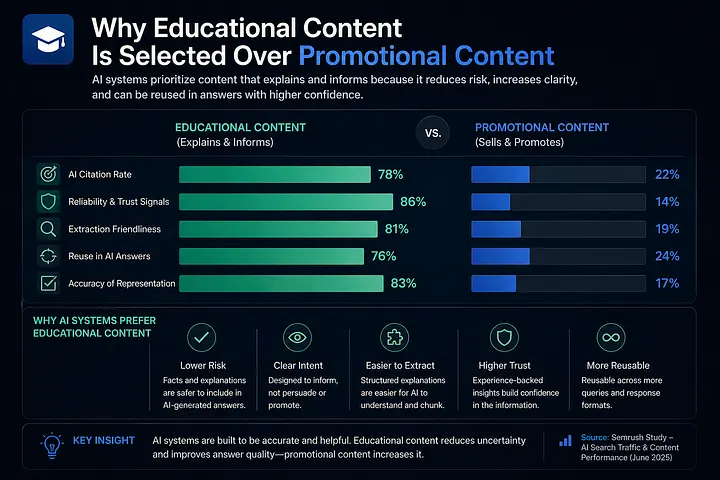
AI systems prefer educational content because it aligns with answer reliability requirements. Educational content explains how something works in a clear way. That makes it easier for the system to use without adding risk.
This one is fairly consistent across most datasets, not just this one. Content that explains things tends to get used more than content that tries to sell something.
The system is trying to answer a question in a way that won’t be challenged. Educational content is easier to trust because it focuses on how something works. Promotional content often includes claims, positioning, or bias, and the system has to decide how much of that to trust.
When that decision becomes harder, the system often looks for a cleaner source. That’s why experience-based explanations, breakdowns, and practical insights keep showing up more than product-led posts.
How Individual and Company Signals Influence Selection
AI systems use both individual and company signals to build confidence in the content they select. Individual profiles provide expertise and authorship signals. Company pages provide structured brand-level information.
The study highlights a split between company pages and individual creators across different AI systems. Some systems lean more toward company content, others toward individuals.
That difference comes down to how each system builds confidence. When both exist and say similar things, the system has something to cross-check. That usually leads to stronger inclusion and more stable representation. When only one side exists, things get a bit thinner, and sometimes that shows up in how the answer is formed.
Why Consistent Publishing Increases AI Visibility
Consistent publishing increases the number of opportunities for AI systems to match content to queries. Each new piece of content creates another potential entry point. More entry points increase the probability of selection.
There’s a strong link between posting frequency and citation in the data. It’s tempting to read that as “post more,” but the underlying reason matters more.
Every piece of content creates another chance to be matched to a query. More content means more surface area the system can pull from. If you only publish occasionally, even strong content has fewer chances to align with real prompts. When you publish consistently, you give the system more opportunities to find something relevant.
Why Engagement Metrics Do Not Drive AI Citations
AI systems prioritize relevance and clarity over engagement when selecting content. Engagement signals do not directly influence whether content can answer a query. This means highly engaged content is not guaranteed to be selected.
The study shows that most cited posts have pretty average engagement. The system is not looking at likes in the same way a human would. It’s looking for content that answers the question.
If a post does that clearly, it can be selected even if very few people interacted with it. If a post gets a lot of engagement but doesn’t answer the question directly, it might not be used at all. That explains why some quiet posts keep appearing in AI answers while louder ones don’t.
What This Means for AI Visibility Strategy Moving Forward
AI visibility is determined by how easily content can be extracted, understood, and trusted. Content that reduces uncertainty is more likely to be selected. Content that introduces ambiguity is less likely to appear.
LinkedIn works well in this environment because the content often carries identity, clarity, and structure by default, but the same rules apply anywhere. If the content is easy to extract and makes sense without needing interpretation, it stands a better chance of being included.
I don’t think this replaces traditional SEO, but it does change how content needs to be written if you want it to show up in these systems. It becomes less about pushing content out and more about making sure the content holds its meaning when it gets pulled apart and rebuilt inside an answer.
Related research articles

AI Search Systems
Google Drops FAQ Rich Results From Search
Google reducing FAQ rich results changes how websites structure informational content for AI visibility, extraction clarity, and AI-generated answers.
2026-05-18 · 7 min read

AI Search Systems
Is FAQ Still Relevant in 2026? What AI Systems Actually Need
FAQ sections can support clarity when they resolve real information gaps, but AI visibility in 2026 depends more on structural containment, extraction clarity, and consistent subject explanation than question formatting.
2026-05-18 · 8 min read

AI Visibility
Why GA4's New AI Assistant Channel Changes How AI Visibility Is Measured
GA4’s new AI Assistant channel groups AI assistant traffic separately from referrals, so AI-generated answer discovery becomes a measurable acquisition layer inside analytics.
2026-05-15 · 8 min read