
Google reducing FAQ rich results changes how many organisations think about structured content. For years, FAQ schema was treated mainly as a way to expand search result visibility, increase click-through rates, and occupy more space inside the search results page.
That behaviour created a pattern where many FAQ sections were written for search appearance rather than informational clarity. Large numbers of websites added repetitive question blocks that existed mainly to trigger rich results rather than genuinely improve understanding.
The change matters because AI systems do not evaluate FAQ content in the same way traditional search snippets did. AI-generated answers rely more heavily on extraction clarity, semantic consistency, and structured explanation than visual SERP enhancements alone. This shift sits inside the broader AI Visibility Framework, where inclusion depends on how clearly systems can interpret structured explanations.
The shift is not simply a loss of visual SERP space. It changes the incentive structure behind FAQ implementation and pushes teams toward content that systems can extract and reuse reliably rather than markup written mainly for appearance.
Key Takeaways
- Google reducing FAQ rich results changes the value of FAQ content but does not remove its importance completely.
- FAQ schema was originally designed to improve structured interpretation, not only search result appearance.
- AI systems still rely heavily on structured question-and-answer formatting during extraction and answer construction.
- Informational clarity is becoming more important than SERP decoration.
- Websites that remove useful FAQ content entirely may weaken AI visibility and extraction consistency.
Why FAQ Rich Results Became Less Important
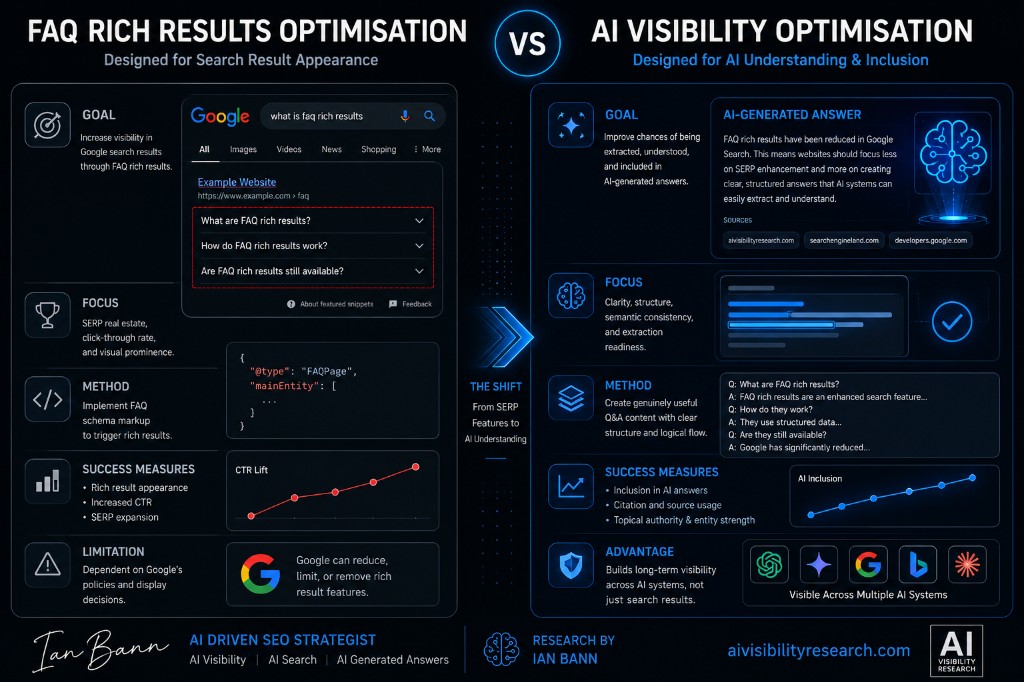
Google reduced FAQ rich results because the search results became saturated with repetitive structured blocks. Large numbers of websites implemented FAQ schema primarily for SERP expansion rather than improving user understanding, which weakened the usefulness of the feature overall.
Google Search Central FAQ documentation reflects how FAQ markup was intended to describe question-and-answer pairs clearly, but widespread implementation for visibility manipulation diluted the display treatment.
This changed the relationship between structured data and visibility. FAQ markup no longer guarantees additional search result space, which means the incentive structure behind FAQ implementation has shifted significantly. Websites can no longer assume that adding FAQ schema automatically improves search appearance.
The important detail is that FAQ content itself did not suddenly lose value. What changed was the visual reward system attached to it. Google reduced the display treatment, but structured explanations and question-based formatting still help systems interpret content more clearly.
That distinction matters because many websites are now considering removing FAQ sections entirely. In some cases that may reduce unnecessary clutter, but removing genuinely useful structured explanations can also weaken semantic clarity and extraction behaviour for AI systems.
AI Systems Use FAQ Content Differently
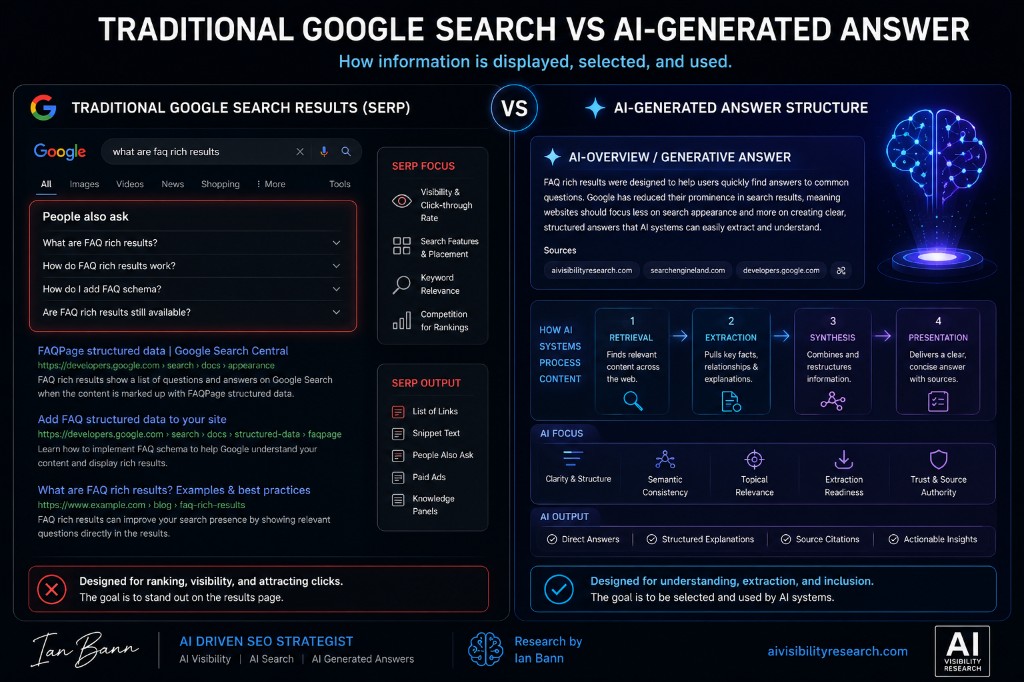
AI systems use FAQ-style content differently from traditional search engines because they are not primarily trying to decorate a results page. Instead, they are trying to retrieve reusable explanations that can support answer construction with minimal uncertainty.
Question-and-answer formatting helps AI systems isolate meaning quickly. When a question directly matches a user query and the answer explains the concept clearly, the system can extract that information with less interpretation effort.
This changes the role of FAQ content inside AI visibility strategies. FAQ sections are becoming less about triggering SERP enhancements and more about supporting extraction reliability, semantic segmentation, and answer reuse.
The structure itself still matters because AI-generated answers often rely on clearly isolated explanations. Content that introduces a question directly and answers it clearly creates lower uncertainty during retrieval. When uncertainty drops, inclusion becomes more likely.
Why Structured Answers Still Matter
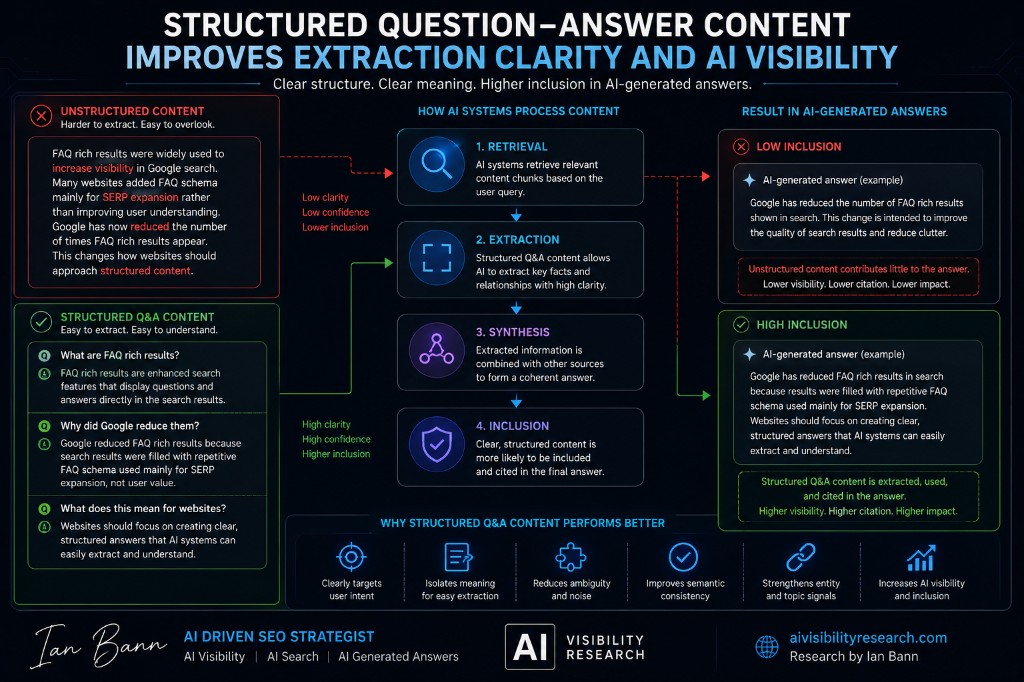
Structured answers remain important because AI systems prefer content that is easy to interpret without heavy rewriting. When explanations are grouped into clearly defined sections, the system can extract relationships more reliably.
This is especially important for informational queries. AI systems often break larger articles into reusable informational units, and structured question-and-answer formatting naturally supports that behaviour. Each section becomes easier to isolate, compare, and reuse.
Google structured data documentation describes how structured markup helps systems interpret page content, but visible explanation quality still determines whether extracted blocks remain usable inside generated answers.
The important shift is that visibility is moving away from cosmetic search enhancements and toward retrieval usability. Informational structure now matters more than visual SERP expansion because AI-generated answers depend on reusable explanation blocks rather than decorative search features.
That means websites should focus less on adding unnecessary FAQ markup and more on creating genuinely useful explanatory content. Clear definitions, stable terminology, and semantic consistency help both users and AI systems interpret information consistently.
What This Means For AI Visibility
Google reducing FAQ rich results does not mean structured informational content has stopped mattering. It means the visibility benefit is changing from search appearance enhancement toward extraction and AI interpretation support.
Extraction clarity depends heavily on whether systems can confidently extract and reuse information. FAQ-style structures still help because they reduce ambiguity, isolate concepts clearly, and improve semantic consistency across the page.
Websites that remove low-quality FAQ spam may improve overall clarity. Websites that remove useful explanatory structures entirely may reduce their ability to support AI-generated answers, especially for informational and comparison queries.
This creates a more important distinction between decorative SEO behaviour and functional AI visibility behaviour. Structured content now matters more for retrieval systems than for visual SERP expansion. For related context, see FAQ relevance in 2026.
Frequently Asked Questions
Did Google completely remove FAQ rich results?
Google did not completely remove FAQ rich results, but it significantly reduced when and where they appear. FAQ rich results are now shown much more selectively than before.
The change reduced the visibility advantage many websites previously gained through FAQ schema implementation. This especially affected websites that used FAQ blocks mainly for search result expansion rather than informational clarity.
Does FAQ schema still matter for AI visibility?
FAQ schema can still support AI visibility because structured question-and-answer formatting improves extraction clarity. AI systems often prefer content that isolates concepts clearly and reduces interpretation effort.
The schema itself is less important than the informational structure behind it. Well-structured explanatory content remains useful even when rich result visibility is reduced.
Should websites remove FAQ sections now?
Websites should remove low-quality or repetitive FAQ sections that exist only for SERP manipulation. Removing unnecessary clutter can improve overall clarity and reduce weak content signals.
However, genuinely useful FAQ sections can still improve semantic structure, extraction reliability, and AI-generated answer inclusion. The value now comes more from explanation quality than search appearance.
Why do AI systems prefer structured answers?
AI systems prefer structured answers because they reduce uncertainty during retrieval and answer construction. Clear question-and-answer formatting helps systems isolate meaning quickly and reuse explanations more reliably.
When content is structured clearly, the system needs less interpretation work. Lower interpretation effort generally increases the likelihood of inclusion inside AI-generated answers.
Is FAQ schema still worth implementing?
FAQ schema is still worth implementing when it supports genuinely useful informational content. The goal should no longer be SERP decoration alone, but improving semantic clarity and structured interpretation.
Websites should focus on creating high-quality explanatory sections rather than adding unnecessary FAQ blocks purely for visibility manipulation.
Final Thoughts
Google reducing FAQ rich results changes the incentive structure around structured informational content, but it does not remove the importance of clear question-and-answer formatting. The role of FAQ content is shifting from visual search enhancement toward extraction support and AI interpretation reliability.
This reflects a broader shift happening across AI visibility. Search systems are increasingly focused on whether information can be extracted, segmented, and reused confidently inside AI-generated answers. Structured explanations help support that behaviour because they reduce ambiguity and improve semantic clarity.
Websites that understand this shift will focus less on cosmetic SERP tactics and more on building reusable informational structures that AI systems can interpret consistently. Browse the full research articles archive for related analysis on extraction, FAQ structure, and AI-generated answer behaviour.
Related research articles

AI Search Systems
Is FAQ Still Relevant in 2026? What AI Systems Actually Need
FAQ sections can support clarity when they resolve real information gaps, but AI visibility in 2026 depends more on structural containment, extraction clarity, and consistent subject explanation than question formatting.
2026-05-18 · 8 min read
AI Search Systems
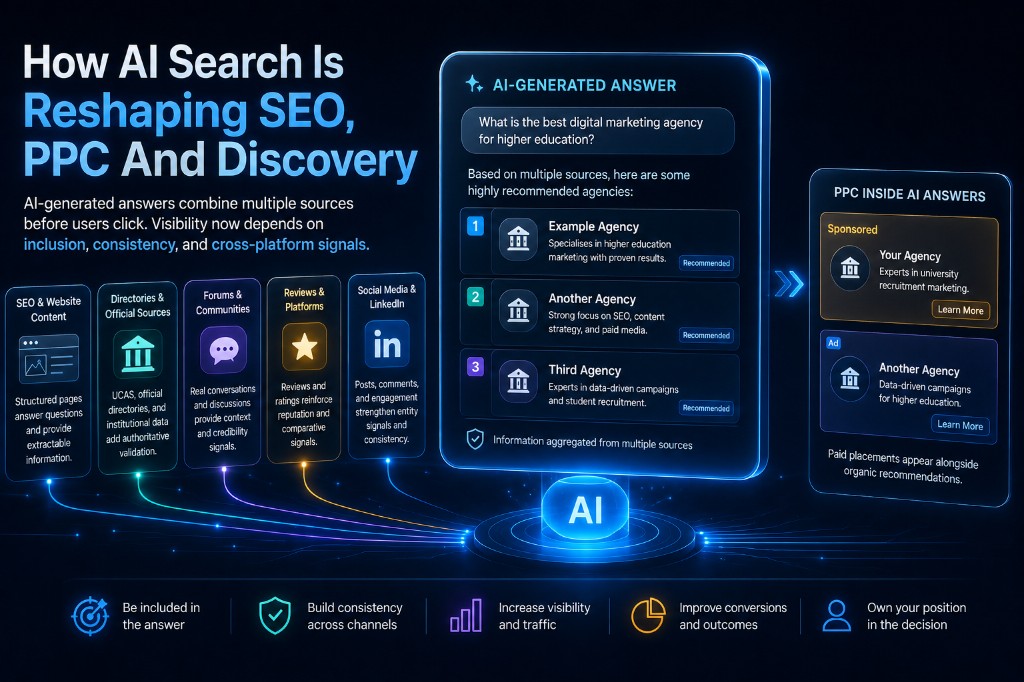
How AI Search Is Reshaping SEO, PPC And Discovery
AI search compresses discovery into structured shortlists before clicks, so SEO, PPC, and cross-platform consistency increasingly decide inclusion inside AI-generated answers.
2026-05-12 · 8 min read

AI Search Systems
How AI Systems Select Agencies In Generated Answers
AI systems select agencies by comparing how they are described across multiple sources before creating a generated shortlist.
2026-05-07 · 7 min read