
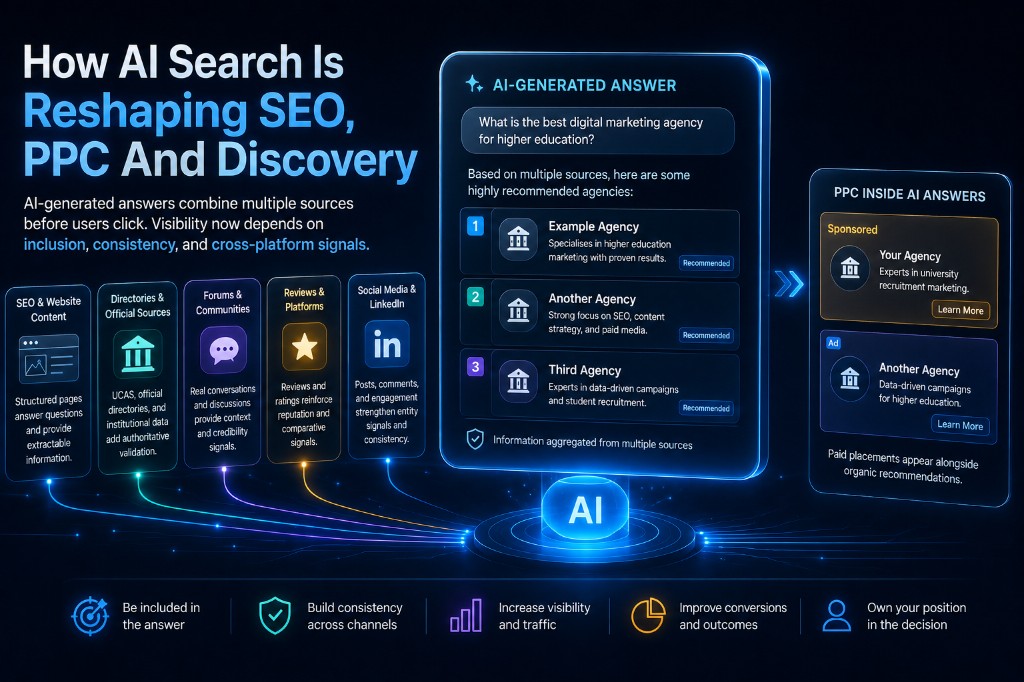
AI systems are changing how agencies are discovered because they no longer present a list of links for users to compare. Instead, they generate a structured answer that already contains a shortlist, which means the decision about which agencies are visible is made before the user visits a single website.
This matters because inclusion is no longer driven by rankings alone. AI systems compare top AI visibility agencies across multiple sources, and that comparison determines whether an agency is included in the final answer or excluded entirely.
AI visibility is determined by how easily your content can be extracted, understood, and reused inside AI-generated answers, which aligns with the AI Visibility Framework.
AI Systems Compare Multiple Sources Before Selecting Agencies
AI systems do not rely on a single website when generating answers. They retrieve information from agency websites, directories, third-party articles, and professional platforms, then compare how each source describes the same agency.
This comparison creates a validation process. When multiple sources describe an agency in the same way, the system can confirm that description as stable and reliable, which increases the likelihood of inclusion. When descriptions differ across sources, the system has to resolve that conflict, which reduces confidence and can lead to exclusion.
Selection Happens Before Traffic Is Created
AI systems generate a shortlist before the user clicks through to any website. The system first interprets the query, retrieves relevant information, compares sources, and then constructs a structured response that already contains selected agencies.
This changes how visibility works. If an agency is not included in that shortlist, it is less likely to be evaluated by the user, even if it performs well in traditional search. The decision layer sits before traffic, which means inclusion determines whether traffic can happen at all.
Consistency Across Sources Determines Inclusion
Consistency is one of the strongest signals used by AI systems when selecting agencies. When the same description appears across a website, directories, and external platforms, it creates a stable reference that the system can match across sources.
When descriptions do not match, the system has to determine which version is correct. That process introduces uncertainty, and uncertainty reduces the likelihood of inclusion. When the same description appears across a university site, UCAS, and forums, AI systems are more likely to include it because it matches across sources. When it doesn’t match, the website is more likely to be excluded.
What AI Systems Evaluate When Comparing Agencies
AI systems evaluate how clearly an agency is defined across multiple sources rather than relying on isolated signals. They compare positioning, services, terminology, and supporting references to determine whether an agency can be included with confidence.
These elements work together as a combined signal. When positioning is clear and consistent, the system can include the agency because the information aligns across sources. When positioning is unclear or inconsistent, the system cannot confidently select it, which reduces visibility inside generated answers.
Why Strong Websites Still Get Excluded
A strong website does not guarantee inclusion because AI systems do not treat it as a single source of truth. They compare it with external references, and the final decision depends on how well those sources align.
This creates a common issue where the website presents one version of the agency, while directories and external content present another. The system cannot resolve which version is correct, so it reduces confidence and may exclude the agency from the answer, even if the website is technically strong.
External Platforms Act As Validation Layers
External platforms play a critical role because they reinforce or weaken how an agency is interpreted. AI systems use platforms such as LinkedIn, Quora, and industry directories to confirm whether the same description appears consistently.
When these platforms repeat the same positioning, they strengthen the overall signal and increase the likelihood of inclusion. When they introduce variation in wording or focus, they create conflicting signals, which reduces the system’s confidence and impacts visibility.
How To Improve Inclusion In AI-Generated Answers
Improving inclusion requires aligning how an agency is described across all platforms rather than focusing on isolated optimisation efforts. The first step is defining a clear positioning statement that can be repeated consistently across websites, content, and external references.
The next step is ensuring that all supporting content reflects that same description. This includes removing conflicting messaging, structuring content so it can be extracted easily, and reinforcing the same terminology across platforms. When these elements align, inclusion becomes more likely. When they conflict, visibility drops.
What This Means For Agencies
Agencies are no longer evaluated only on rankings or traffic performance. They are evaluated on how clearly and consistently they are represented across the web, because that determines whether AI systems can include them in generated answers.
This shifts the focus from isolated tactics to coordinated positioning. If an agency is not aligned across sources, it becomes harder for AI systems to include it. If it is aligned, it becomes easier for the system to select it and present it within the shortlist that shapes user decisions.
FAQ
How do AI systems select agencies?
AI systems select agencies by comparing how they are described across multiple sources and identifying consistent patterns. They evaluate websites, directories, and external content to determine whether an agency’s positioning is clear and reliable.
When descriptions align, the system can confirm that positioning and include the agency with higher confidence. When descriptions differ, the system has to resolve that conflict, which reduces confidence and can lead to exclusion from generated answers.
Why is consistency across platforms important?
Consistency across platforms is important because AI systems rely on multiple sources to build and validate answers. When the same description appears across those sources, it creates a stable reference that the system can match and trust.
When descriptions differ, the system has to decide which version is correct, which introduces uncertainty. That uncertainty reduces the likelihood of inclusion, making consistency a direct factor in visibility.
Can a strong website guarantee inclusion?
A strong website does not guarantee inclusion because AI systems do not rely on a single source when generating answers. They compare the website with external references to determine whether the information is consistent.
If the website’s description does not match what appears elsewhere, the system cannot confirm it confidently. This reduces the likelihood of inclusion, even if the website performs well in traditional search rankings.
What role do external platforms play?
External platforms act as validation layers that confirm whether an agency’s positioning is consistent across sources. AI systems use these platforms to compare descriptions and identify patterns.
When external content reinforces the same message, it strengthens the signal and increases the likelihood of inclusion. When it introduces variation, it creates conflicting signals that reduce confidence and impact visibility.
How can agencies improve AI visibility?
Agencies can improve AI visibility by aligning how they are described across all platforms and ensuring that messaging remains consistent. This involves defining a clear positioning statement, repeating it across websites and external content, and structuring information so it can be easily extracted.
Removing conflicting messaging is essential because inconsistency reduces confidence. Visibility improves when signals reinforce each other across multiple sources.
Closing
AI systems are not discovering ai visibility agencies in the same way search engines did. They are selecting them by comparing how they are described across multiple sources, then generating a shortlist that shapes what the user sees first.
This means visibility is no longer defined by where you rank, but by whether your agency can be clearly understood and consistently validated across the web. When positioning aligns across platforms, it becomes easier for AI systems to include it. When it does not, the system has less confidence, and the agency is more likely to be excluded before the user even considers it.
Related research articles

AI Search Systems
Google Drops FAQ Rich Results From Search
Google reducing FAQ rich results changes how websites structure informational content for AI visibility, extraction clarity, and AI-generated answers.
2026-05-18 · 7 min read

AI Search Systems
Is FAQ Still Relevant in 2026? What AI Systems Actually Need
FAQ sections can support clarity when they resolve real information gaps, but AI visibility in 2026 depends more on structural containment, extraction clarity, and consistent subject explanation than question formatting.
2026-05-18 · 8 min read
AI Search Systems
How AI Search Is Reshaping SEO, PPC And Discovery
AI search compresses discovery into structured shortlists before clicks, so SEO, PPC, and cross-platform consistency increasingly decide inclusion inside AI-generated answers.
2026-05-12 · 8 min read