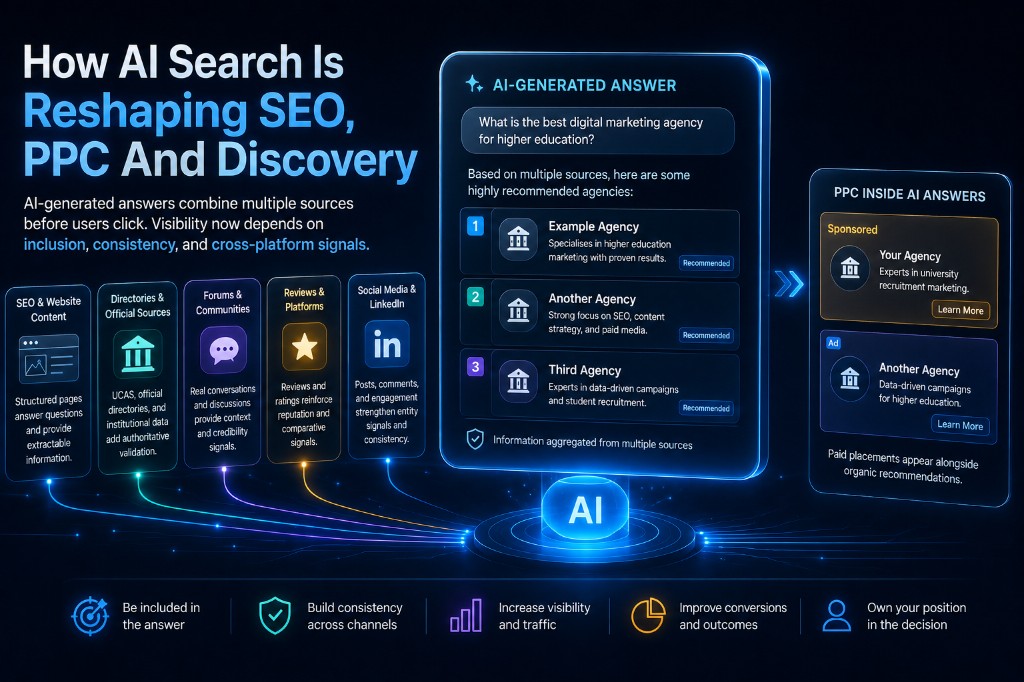
AI search is changing discovery because it removes the need for users to compare multiple sources themselves. Instead of opening multiple pages, users ask a question and receive a structured answer that already contains a shortlist of options.
This changes how visibility works because the shortlist is created before the click happens. The AI system decides what gets included first, and that decision influences what the user evaluates next.
If a brand is not included in that initial answer, the opportunity to influence the decision becomes smaller. Traditional rankings still matter, but they are no longer the only factor shaping visibility. Teams can map those layers using the AI visibility framework.
Key Takeaways
- AI search changes discovery because users now receive structured answers before clicking through to websites.
- AI systems compare multiple sources simultaneously rather than relying on one website alone.
- SEO now influences how information is extracted and reused inside AI-generated answers.
- PPC is moving closer to the decision layer because ads appear alongside AI-generated shortlists.
- Cross-platform consistency increasingly determines whether brands are included or excluded from AI-generated answers.
How AI Search Builds Answers Across Multiple Channels
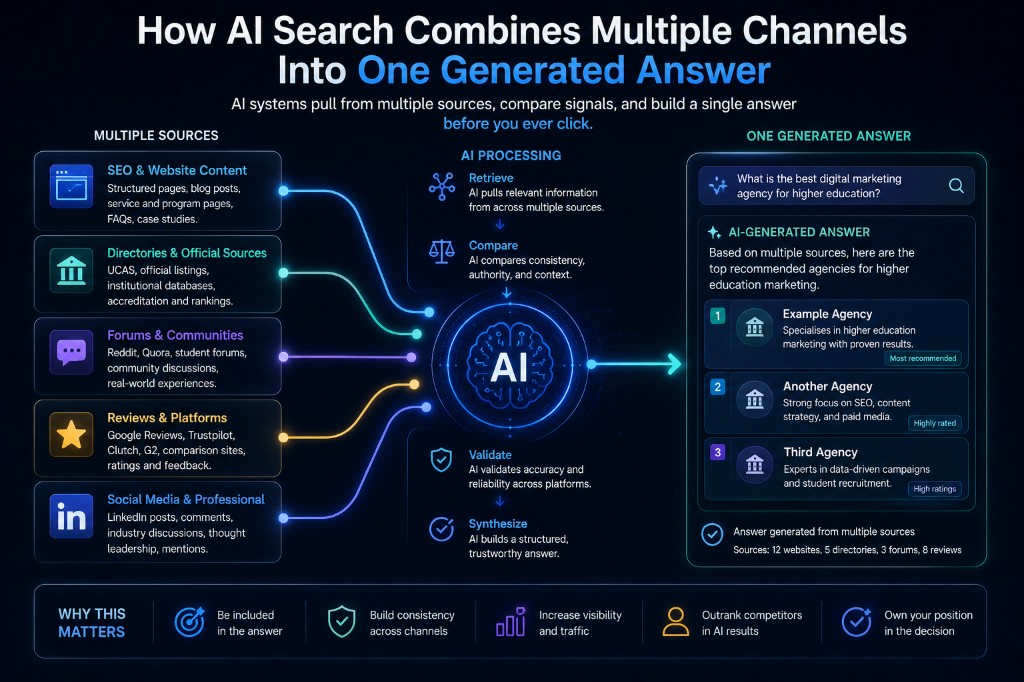
AI search systems build answers by combining information from multiple platforms at the same time. They retrieve information from websites, directories, forums, reviews, and third-party sources, then assemble that information into one generated response.
This means AI systems are not evaluating pages in isolation anymore. They are comparing how the same organisation, product, or service is described across different environments to determine whether the information is reliable enough to include.
When descriptions remain consistent across multiple sources, inclusion becomes more likely because the system can validate the information more confidently. When descriptions conflict, uncertainty increases, and uncertainty often reduces visibility inside AI-generated answers.
Why SEO Now Focuses On Extraction And Interpretation
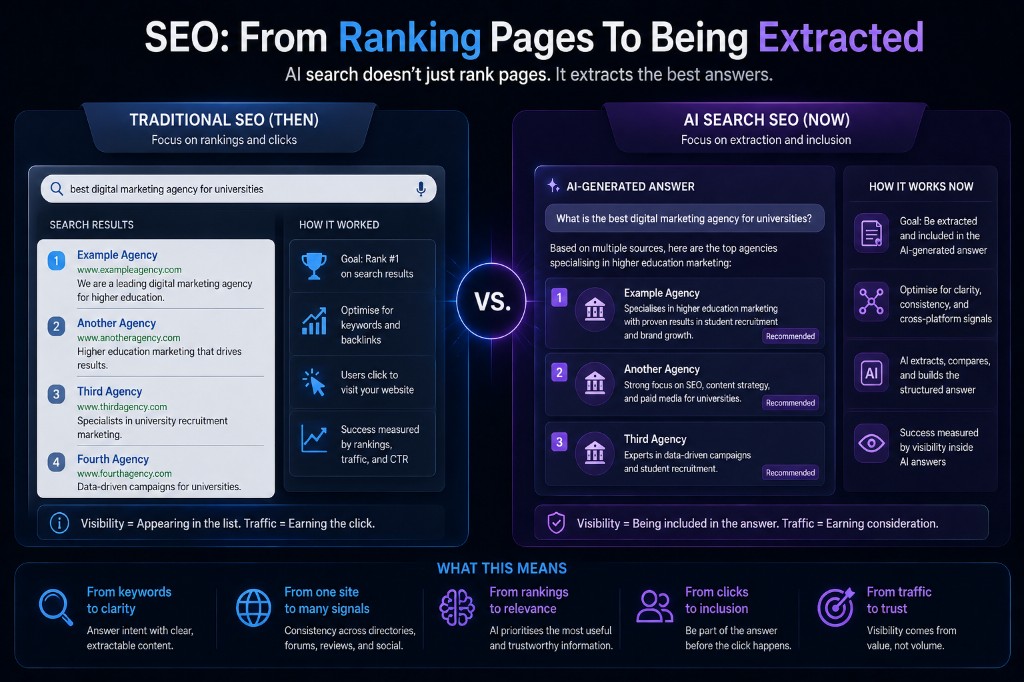
AI increasingly affects how information is interpreted rather than simply how pages rank. AI systems need content that clearly explains concepts, answers questions directly, and presents information in a reusable structure.
Pages that rely on long introductions, vague wording, or inconsistent terminology create more interpretation work for the system. If different sections describe the same topic differently, the system has to decide which version is correct before it can reuse the information.
This changes what effective optimisation looks like. Consistent terminology, direct explanations, structured headings, and clearly defined outcomes make content easier to extract and reuse inside AI-generated answers. Google documents how AI summaries can appear in search in its Google AI Overviews Documentation.
Why Social Platforms And Third-Party Sources Matter More
Social platforms and third-party websites increasingly influence whether information is trusted. AI systems compare external references to determine whether the same positioning appears consistently across multiple environments.
This is one reason forums, student discussions, review platforms, LinkedIn posts, and directory listings are appearing more frequently inside AI-generated answers. They act as validation layers that help the system confirm whether information aligns across sources.
When multiple sources reinforce the same description, the AI system can treat that description as more stable. When external sources contradict the website, the system has to resolve those conflicts before deciding whether inclusion is appropriate. LinkedIn content inside AI answers is one of the clearer examples of how professional platforms enter that validation layer, which aligns with independent work such as the Semrush AI Visibility Research on LinkedIn visibility in AI outputs.
How PPC Is Moving Closer To The Decision Layer
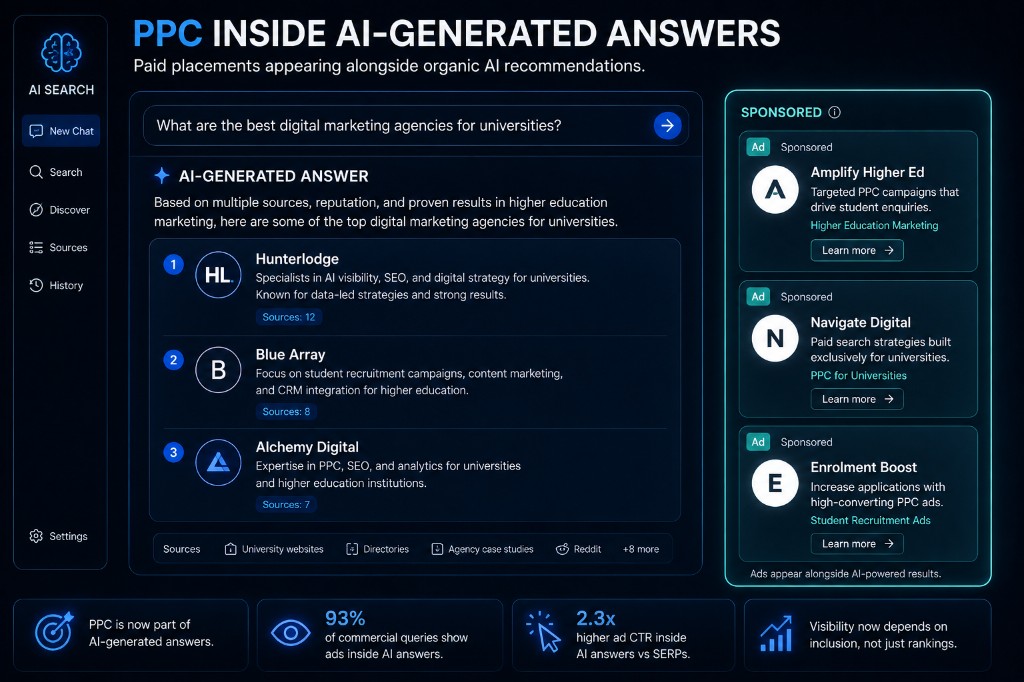
PPC is changing because AI-generated answers now influence the decision process before paid placements appear. AI Ads are increasingly being tested directly inside AI-generated interfaces, placing paid options alongside organic recommendations.
This changes how campaigns need to align with visibility strategy. The ad is no longer introducing the brand for the first time because the user has already been exposed to a shortlist before the ad appears.
If the PPC message reinforces the same positioning already shown inside the AI-generated answer, it strengthens consistency. If it introduces conflicting claims or language, it creates friction between the ad and the surrounding answer environment. For how conversational search and retrieval are converging in shipped products, see OpenAI Search And Retrieval Overview.
Why Platform Behaviour Now Shapes Visibility Outcomes
AI platforms influence discovery because each platform assembles answers differently. Some systems prioritise structured official sources more heavily, while others rely more on discussion-based content and broader retrieval behaviour.
This means the same question can produce different answers across platforms. Visibility is not fixed because every AI system applies different weighting to sources, authority signals, extraction patterns, and comparison behaviour.
Understanding platform behaviour becomes part of the visibility strategy itself. Brands increasingly need to understand how different AI systems retrieve, compare, and present information if they want consistent inclusion across AI-generated answers.
Why AI Search Compresses The Discovery Journey
Traditional discovery involved multiple stages. Users searched, compared different pages, reviewed multiple sources, and gradually narrowed their options over time.
AI search compresses much of that behaviour into a single interaction. The system presents a shortlist immediately, which means fewer alternatives are explored before the decision process begins.
This creates a more concentrated visibility environment where inclusion becomes more important than ranking alone. Brands are increasingly competing for presence inside the answer itself rather than competing only for clicks.
What This Means For AI Visibility Strategy
AI search connects SEO, PPC, social platforms, directories, and third-party references into one combined visibility system. Each channel contributes a different layer that influences how the final answer is assembled.
SEO provides extractable structured information. Social and third-party platforms reinforce validation and consistency. PPC introduces paid positioning into the same decision environment where organic inclusion already exists.
This shifts strategy away from isolated channel optimisation and toward cross-platform alignment. Visibility increasingly depends on whether AI systems can consistently interpret the same positioning across all sources they retrieve. For a connected view of how discovery is changing in practice, see AI visibility strategy in the companion article on digital discovery.
Frequently Asked Questions
How does AI search change traditional SEO?
AI search changes SEO because systems now reuse extracted information directly inside generated answers. This means content must be structured clearly enough for AI systems to interpret and reuse confidently.
Traditional rankings still matter, but visibility increasingly depends on extraction clarity, consistency, and whether the information aligns across multiple sources.
Why are forums and third-party platforms appearing more often in AI answers?
Forums and third-party platforms provide additional validation layers for AI systems. They help confirm whether information matches across different environments, which reduces uncertainty during answer generation.
When AI systems find consistent descriptions across official sites, forums, and directories, they can include that information with greater confidence.
How is PPC affected by AI-generated answers?
PPC is moving closer to the decision stage because ads are increasingly appearing inside AI-generated answer environments. Users may already see a shortlist before the ad is presented.
This means ad messaging needs to align with the positioning already shown in the answer. Consistency between paid and organic visibility becomes more important.
Why does consistency across platforms matter for AI visibility?
Consistency matters because AI systems compare multiple sources before generating answers. When descriptions align across websites, social platforms, directories, and external references, the system can validate the information more easily.
Conflicting descriptions increase uncertainty, which can reduce the likelihood of inclusion inside AI-generated answers.
Final Thoughts
AI search is reshaping discovery by reducing the number of steps between the question and the decision. Users increasingly receive structured answers immediately, which changes how brands become visible during the evaluation process.
This shifts visibility away from isolated rankings and toward inclusion within AI-generated answers themselves. SEO, PPC, social platforms, and third-party validation now operate as connected layers inside one larger AI visibility system.
Brands that align positioning consistently across those layers are easier for AI systems to interpret and include. Brands that present fragmented or conflicting signals create uncertainty, and uncertainty increasingly affects whether they appear inside the answers users see first.
Related research articles

AI Search Systems
Google Drops FAQ Rich Results From Search
Google reducing FAQ rich results changes how websites structure informational content for AI visibility, extraction clarity, and AI-generated answers.
2026-05-18 · 7 min read

AI Search Systems
Is FAQ Still Relevant in 2026? What AI Systems Actually Need
FAQ sections can support clarity when they resolve real information gaps, but AI visibility in 2026 depends more on structural containment, extraction clarity, and consistent subject explanation than question formatting.
2026-05-18 · 8 min read

AI Search Systems
How AI Systems Select Agencies In Generated Answers
AI systems select agencies by comparing how they are described across multiple sources before creating a generated shortlist.
2026-05-07 · 7 min read