
FAQ sections can support clarity when they resolve real information gaps, but AI visibility in 2026 depends more on structural containment, extraction clarity, and consistent subject explanation than question formatting.
FAQ sections became one of the most repeated recommendations during the first wave of AI-generated answers. As conversational AI tools became more common, many websites assumed that question-and-answer formatting automatically improved AI visibility because users were increasingly typing full questions into AI systems and search interfaces.
That assumption simplified the problem too much. AI systems do not prioritise FAQ formatting because it looks organised. They prioritise content that explains a subject clearly, consistently, and without forcing the system to assemble meaning across fragmented layouts.
The important shift in 2026 is that AI systems are evaluating whether a page resolves intent cleanly rather than whether it simply mirrors conversational query formatting. FAQ sections can support that process in some situations, but they are not the mechanism driving inclusion.
AI visibility is determined by how easily your content can be extracted, understood, and reused inside AI-generated answers.
Key Takeaways
- FAQ sections are not required for AI visibility in 2026.
- AI systems extract from structurally clear explanations, not from question formatting alone.
- Retrieval, extraction, and synthesis are separate behaviours.
- Structural containment matters more than repeated FAQ formatting.
- FAQ sections help when they resolve genuine information gaps clearly.
The Conversation That Changed My View
This became obvious during a discussion about university course pages. Ian Bann recommended adding FAQ sections as part of an AI visibility strategy because question-and-answer formatting can create clean answer blocks that are easier to interpret structurally.
The response pushed back against the assumption behind the recommendation. The client argued that their pages already explained the programme clearly and questioned whether FAQ sections were actually necessary if the core explanation was already visible and structured.
That forced a closer look at the mechanism itself instead of defending the pattern. If a page already defines the subject clearly, explains who it is for, and presents the structure visibly, then what does FAQ formatting actually change?
The answer is that FAQ sections only help when they improve extraction clarity. If the page already resolves the subject directly, repeated question blocks can sometimes fragment the explanation instead of strengthening it.
Why Everyone Started Adding FAQ Sections
Question-led formatting became popular because users increasingly interacted with AI tools using natural language prompts. The industry reacted by trying to mirror those patterns directly inside page structures.
That approach can help retrieval because question headings often align closely with prompt phrasing. However, retrieval alone does not determine whether content becomes reusable inside an AI-generated answer. Google Search Central guidance on helpful content still centres on whether the page resolves intent clearly, not on whether it mimics conversational phrasing.
If the explanation underneath the question is vague, indirect, or padded with marketing language, the system still struggles to use it. The strength is in the explanation itself, not in the question format.
Retrieval, Extraction, and Synthesis Are Different Things
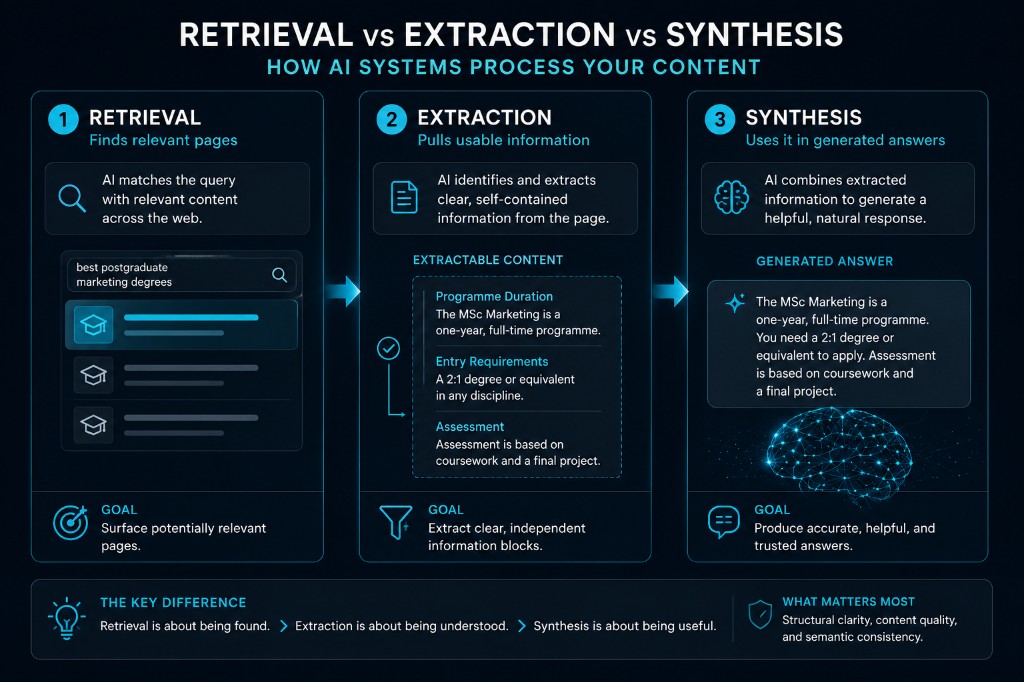
To understand why FAQ sections are not the main variable anymore, it helps to separate retrieval, extraction, and synthesis into different behaviours.
Retrieval determines whether a page is surfaced as relevant to a query. Extraction determines whether a paragraph can be isolated and reused independently. Synthesis determines whether the extracted material can be integrated confidently into a generated answer.
Using questions can support retrieval because the heading resembles the user query. However, extraction and synthesis still depend on whether the explanation itself resolves the subject directly and consistently.
That distinction matters because many pages optimise for retrieval patterns while ignoring extraction quality. A page can match a query successfully and still fail to become reusable inside AI-generated answers.
What AI Systems Actually Look For
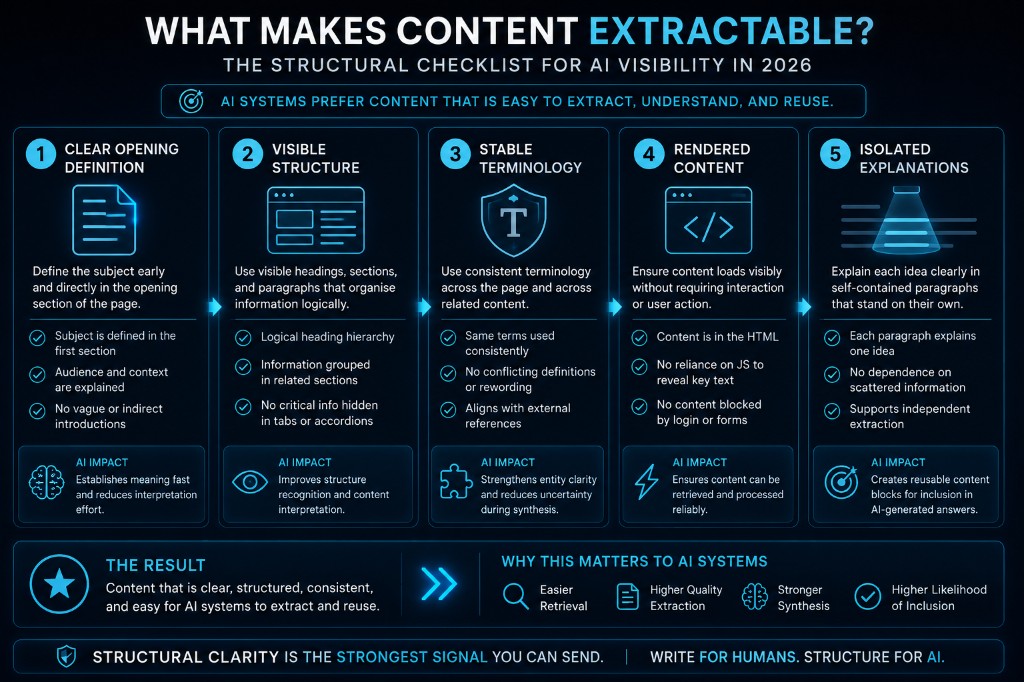
AI systems extract from sections that explain a subject clearly without requiring additional interpretation. They favour visible structures where meaning is concentrated instead of scattered across interactive elements and disconnected sections.
Several structural patterns repeatedly appear in extractable content. The subject is usually defined early, the audience is identified clearly, and the explanation remains self-contained without relying on hidden tabs or expandable modules.
Terminology consistency also matters because stable wording reduces uncertainty during synthesis. When definitions shift repeatedly across sections or related pages, the system has to interpret whether the subject is actually the same thing. Semantic consistency across related pages reduces that uncertainty.
If those structural conditions are present, the content becomes easier to reuse. If they are missing, FAQ formatting does not compensate for the underlying clarity problem.
Clear Explanations Matter More Than Formatting
A clean FAQ heading cannot rescue a weak explanation underneath it. AI systems still evaluate whether the content resolves the subject directly, not whether the formatting resembles conversational search behaviour.
When explanations rely on vague positioning statements, marketing language, or indirect introductions, extraction becomes more difficult. A simple heading followed by a direct explanation is often more reusable than a perfectly formatted FAQ block containing weak answers.
AI systems prioritise usable statements because they reduce interpretation effort during synthesis. Formatting alone does not create clarity. The explanation itself creates clarity.
This is why educational content often performs better inside AI-generated answers than heavily promotional content. Educational explanations usually define the subject earlier and maintain more stable terminology throughout the page.
Why Scattered Information Creates Problems
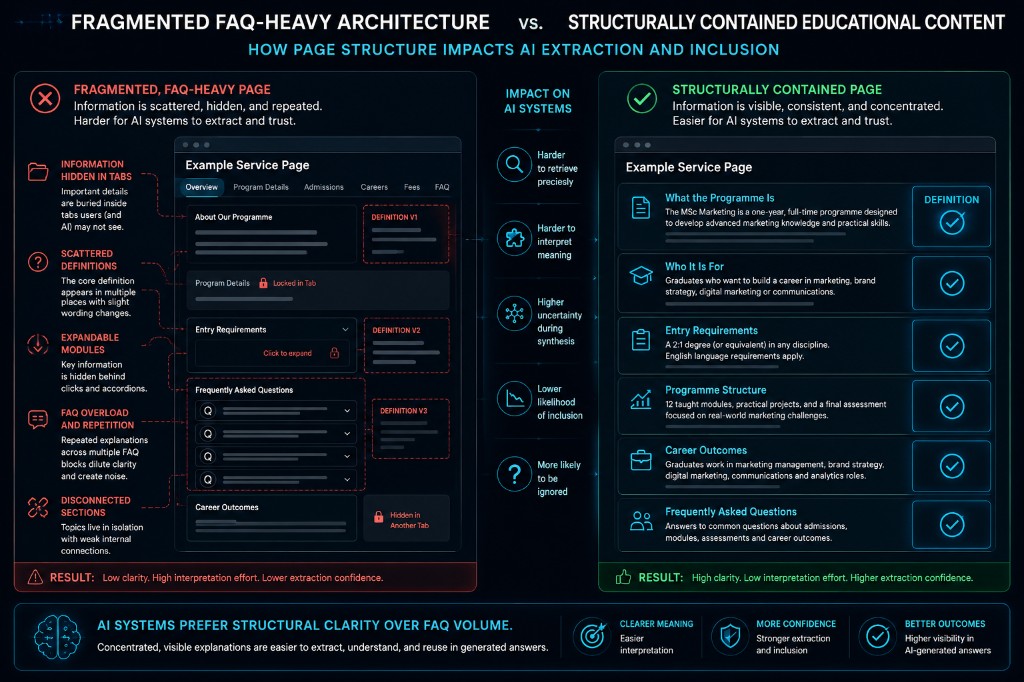
Structural containment matters because AI systems prefer pages where the primary explanation exists visibly in one concentrated location. The easier it is to locate the definition and supporting information, the easier it becomes to reuse the page confidently.
Problems begin when explanations are split across tabs, expandable modules, duplicated definitions, and repeated FAQ sections. The information may technically exist, but the meaning becomes fragmented across the page structure.
Take a typical university programme page as an example. One version may open with broad positioning language before eventually explaining what the programme actually is. Entry requirements sit inside a tab, assessment details appear lower down inside FAQs, and career outcomes live inside expandable sections.
Another version may define the programme clearly in the opening paragraph, explain who it is for immediately, and present assessment, entry requirements, and outcomes in visible sections within the main body of the page.
The second structure is easier for AI systems to interpret because the explanation is concentrated instead of fragmented. The difference is not whether FAQ exists. The difference is whether the subject is explained clearly in one visible place.
When FAQ Sections Actually Help
FAQ sections still provide value when they resolve specific information gaps that are not naturally answered in the main explanation.
For example, a course page may explain the programme structure clearly but fail to answer whether international students require a portfolio or whether work experience is mandatory. In those situations, a short FAQ section can consolidate unresolved practical details in one visible location.
FAQ sections become useful when they support clarity without duplicating the main definition repeatedly. They become less useful when they restate information that already exists higher up the page.
Repeated definitions often weaken structural containment because the explanation becomes split across multiple locations. AI systems work better when a subject is defined clearly once and then supported consistently.
When FAQ Sections Make Pages Harder to Understand
FAQ sections become a problem when they repeat explanations the page has already established clearly. If the introduction defines the subject properly and the FAQ later redefines it in slightly different language, the page starts presenting multiple competing versions of the same idea.
That weakens semantic stability because the explanation no longer exists in one concentrated place. Instead, the reader and the AI system both have to assemble meaning from repeated fragments across the page.
This becomes more noticeable when terminology shifts slightly between sections. One area may describe the programme one way while another section rephrases it differently to sound varied or more promotional.
AI systems generally perform better when explanations remain stable rather than repeatedly rewritten. Repetition without added clarity introduces unnecessary interpretation effort.
What Makes Content Easier for AI Systems to Use
Pages become more reusable inside AI-generated answers when the structure explains the subject clearly from the beginning and maintains consistency throughout the page. Extract and reuse behaviour depends on whether isolated paragraphs remain understandable without surrounding context.
The opening section usually matters most because it establishes the definition early. Supporting sections then reinforce that explanation without changing terminology, splitting meaning, or hiding important information behind interactive design patterns.
Pages tend to perform better when:
- One main page explains the topic clearly from beginning to end
- The first section defines the subject directly
- Paragraphs explain ideas fully without depending on hidden tabs
- Terminology remains stable across related pages
- Links between pages reinforce topical relationships
- Content loads visibly and can be rendered cleanly
When those conditions are present, AI systems can understand and reuse the material more confidently. FAQ formatting does not replace any of that structural work. W3C accessibility guidance reinforces that visible, renderable structure supports both human comprehension and machine interpretation.
What Changed in 2026
The shift in 2026 is not mainly about conversational formatting anymore. It is about whether a page explains a subject clearly enough for an AI system to reuse confidently.
Pages that define the topic directly at the top, maintain stable terminology, and avoid fragmented design patterns are easier to interpret. Pages that spread explanations across expandable modules, repeated definitions, and disconnected FAQ blocks create more uncertainty during synthesis. Structural clarity is increasingly the variable that separates extractable pages from fragmented ones.
FAQ sections still help in situations where important questions genuinely remain unresolved. They are not the reason a page becomes extractable inside AI-generated answers.
That distinction changes how AI visibility strategies should be approached. The strongest pages are not necessarily the pages with the most FAQ blocks. They are the pages where the explanation is concentrated, visible, stable, and easy to interpret.
Frequently Asked Questions
Do FAQ sections still help AI visibility?
FAQ sections can still support retrieval and user clarity when they answer unresolved questions directly. However, AI visibility depends more on structural clarity, extraction quality, and semantic consistency than on question formatting alone.
If the page already explains the subject clearly, adding repeated FAQ blocks may not improve extraction. In some situations, duplicated explanations can reduce structural clarity instead of strengthening it.
Why do AI systems prefer structurally contained pages?
Structurally contained pages reduce interpretation effort during extraction and synthesis. When the subject is explained clearly in one visible location, the system can reuse the information more confidently.
Fragmented structures force the system to assemble meaning across tabs, expandable modules, and disconnected sections. That increases uncertainty and weakens extraction reliability.
Can FAQ schema improve inclusion in AI-generated answers?
FAQ schema can support machine-readable structure, but it does not guarantee inclusion. AI systems still evaluate whether the visible content explains the subject clearly and consistently.
Schema.org TechArticle documentation describes technical article structure, but schema reinforces existing clarity. It does not compensate for weak explanations, fragmented structure, or inconsistent terminology.
What matters more than FAQ formatting?
The most important factors are clear definitions, visible explanations, stable terminology, rendered content, and concentrated subject containment.
Pages perform better when the explanation is direct and easy to interpret without requiring additional reconstruction from scattered interface elements.
Why This Matters
FAQ sections are still useful in specific situations, but they are no longer the defining factor behind AI visibility. AI systems are increasingly evaluating whether a subject is explained clearly and consistently rather than whether the page mirrors conversational search behaviour.
That changes how content should be structured in 2026. The strongest pages are not the ones with the most question blocks. They are the pages where the explanation is concentrated, visible, stable, and easy to reuse inside AI-generated answers.
For related analysis across the research articles archive, see how extraction, attribution, and recommendation behaviour connect inside the broader AI visibility framework.
Related research articles

AI Search Systems
Google Drops FAQ Rich Results From Search
Google reducing FAQ rich results changes how websites structure informational content for AI visibility, extraction clarity, and AI-generated answers.
2026-05-18 · 7 min read
AI Search Systems
How AI Search Is Reshaping SEO, PPC And Discovery
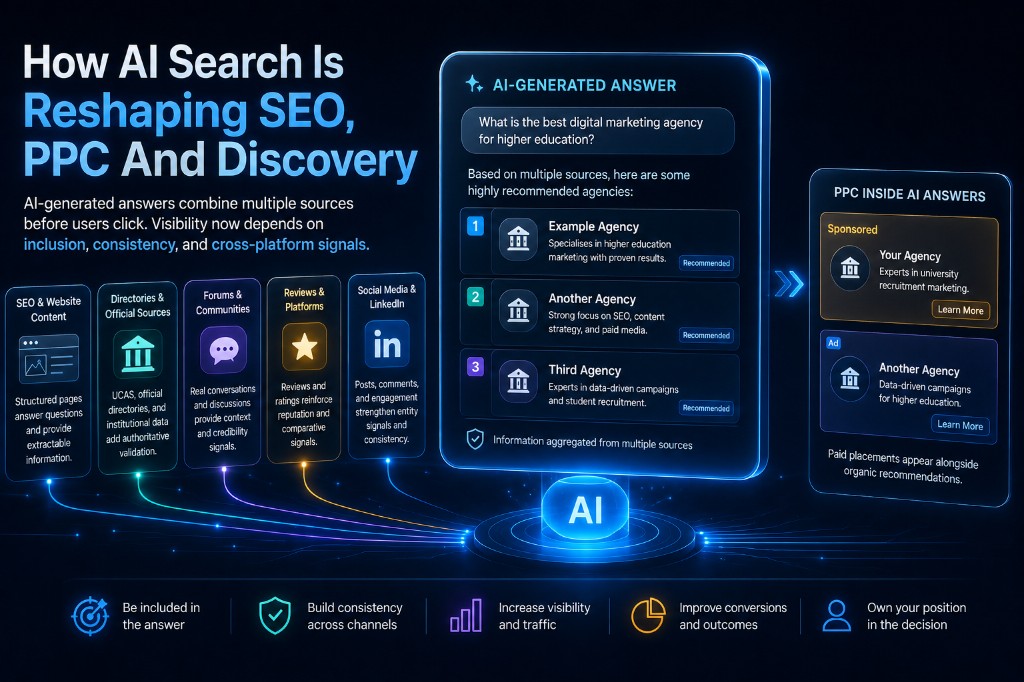
AI search compresses discovery into structured shortlists before clicks, so SEO, PPC, and cross-platform consistency increasingly decide inclusion inside AI-generated answers.
2026-05-12 · 8 min read

AI Search Systems
How AI Systems Select Agencies In Generated Answers
AI systems select agencies by comparing how they are described across multiple sources before creating a generated shortlist.
2026-05-07 · 7 min read