Ian Bann portrait, AI-driven SEO strategist specialising in AI visibility and search behaviour analysis

AI Search Visibility & Authority Analysis

Ian Bann

Ian Bann is an AI-driven SEO strategist focused on diagnosing how authority and visibility break inside AI-generated search results.

His work examines AI search visibility, attribution behaviour, and why strong websites lose visibility despite strong traditional SEO signals.

Research metrics

20,000+

prompts tested

4

visibility layers tracked

20,000+

AI-generated answers analysed

3

sectors observed

AI search behaviour

What is AI search?

AI search starts with a question and returns a structured answer instead of a list of links. The system selects, summarises, and prioritises sources before the user ever visits a website. This is the foundation for how AI systems interpret information, which is explored in the ai visibility research page.

+Tools

Some universities make teaching and assessment far more visible than others. These are the kinds of institutions that reduce uncertainty by showing workload, structure, and practical expectations clearly.

Universities that make postgraduate teaching and assessment visible

University of Dundee

  • Explains how modules are taught and how students are assessed
  • Shows a mix of essays, reflective work, and applied projects

Good for seeing academic and practical assessment together.

University of Worcester

  • Provides clear guidance on attendance, directed study, and formal assessment
  • Makes written work, teaching evaluation, and portfolio expectations easier to understand

Useful for understanding workload and structure in more detail.

University of Gloucestershire

  • Shows practical assessment types such as lesson observation and planning submission
  • Includes portfolio-style evidence linked to real teaching contexts

Helps show how practical postgraduate study can feel in reality.

This is a simulated search sequence designed to show how AI systems shape discovery before the click.

AI Visibility Analysis

How AI visibility is analysed

This view groups the signals used to assess why a brand is more likely to appear, be cited, or be recommended inside AI-generated answers.

AIVisibility
What this work examines

What determines AI visibility

The key AI visibility framework factors that determine whether a brand is selected, cited, or ignored inside AI-generated answers.

  1. AI visibility is not traditional SEO

    AI does not rank pages. It selects sources.

    Pages can rank highly and still be ignored if they are difficult to extract, unclear, or hard to verify inside AI-generated answers. AI visibility is about source selection, summarisation, citation, and whether a system trusts the page enough to use it.


  2. Clarity beats authority

    AI systems prefer content that reduces ambiguity.

    When information is clearly structured, directly answers the question, and uses consistent terminology, it is often easier for AI systems to extract and trust than broader, more authoritative pages that are harder to interpret.

  3. Structure determines inclusion

    AI systems rely on structure to extract meaning.

    When key information is buried, inconsistent, split across sections, or wrapped in narrative language, extraction becomes less reliable. Clear headings, direct answers, and stable formatting increase the likelihood of inclusion.

  4. Consistency builds trust

    AI systems cross-check information across multiple sources.

    Conflicting wording, unclear attribution, and inconsistent signals reduce confidence. When an entity, message, or explanation is repeated clearly across trusted environments, visibility becomes more stable.

  5. Authority is contextual

    Authority depends on the question being asked.

    AI systems do not reward domain strength in the abstract. They prefer sources that best match the intent of the prompt, explain the topic clearly, and provide information that feels directly usable in the answer.

  6. Visibility can be diagnosed

    AI visibility is observable through patterns.

    By reviewing which sources are cited, ignored, summarised, or replaced, it is possible to trace visibility back to structure, clarity, corroboration, entity signals, and technical readiness. This makes AI visibility diagnosable in practice, not theoretical.

AI visibility behaviour

Ranking does not equal visibility

How source selection, citation, and dominance differ across AI-generated answers.

Source selection rateSource citation rateSource dominance rate

Based on analysis of AI-generated answers across real search queries and source selection patterns.

Analysis infrastructure

Technology and AI systems used to analyse visibility

Different ai tools are used to review search visibility, compare competitors, and analyse patterns of how websites show up in Ai search results.

  • 馃搳Authority and visibility tracking

    Measures how brands appear across search and AI-generated environments

  • 馃攳Cross-platform answer comparison

    Identifies how responses differ between AI systems and which sources are selected

  • 馃Extraction and interpretation analysis

    Evaluates how content is parsed, structured, and reused inside AI-generated answers

Research and writing

Research articles

Latest articles expanding on AI visibility research, frameworks, and real-world analysis. Visit the research page for on-site query breakdowns.

Structured AI search interface showing disappearing FAQ rich results beside AI-generated answers, extraction panels, semantic analysis systems, and AI content interpretation workflows. The visual compares traditional Google SERP FAQ features with AI-generated answer construction and structured extraction behaviour. Research visual by Ian Bann, an AI-driven SEO strategist focused on diagnosing how authority and visibility break inside AI-generated search results.

AI Search Systems

Google Drops FAQ Rich Results From Search

Google reducing FAQ rich results changes how websites structure informational content for AI visibility, extraction clarity, and AI-generated answers.

2026-05-18 路 7 min read

Related framework: AI Visibility Framework

Futuristic AI visibility research graphic comparing a fragmented FAQ page structure with a structurally clear content layout optimized for AI-generated answers, using glowing interface panels, neural network visuals, and AI processing graphics.

AI Search Systems

Is FAQ Still Relevant in 2026? What AI Systems Actually Need

FAQ sections can support clarity when they resolve real information gaps, but AI visibility in 2026 depends more on structural containment, extraction clarity, and consistent subject explanation than question formatting.

2026-05-18 路 8 min read

Related framework: AI Visibility Framework

Dark AI search interface showing a chatbot search bar and query prompts, representing how AI systems select agencies in generated answers.

AI Search Systems

How AI Systems Select Agencies In Generated Answers

AI systems select agencies by comparing how they are described across multiple sources before creating a generated shortlist.

2026-05-07 路 7 min read

Related framework: AI Visibility Framework

AI-generated search interface visual representing AI optimisation agencies in the UK, showing how AI systems compare and shortlist agencies before clicks. Research by Ian Bann, AI-driven SEO strategist focused on AI visibility and AI-generated search behaviour.

AI Visibility

Top AI Optimisation Agencies in the UK (2026)

AI systems compare agency positioning, consistency, and structured visibility signals before generating shortlists.

2026-05-07 路 10 min read

Related framework: AI Visibility Framework

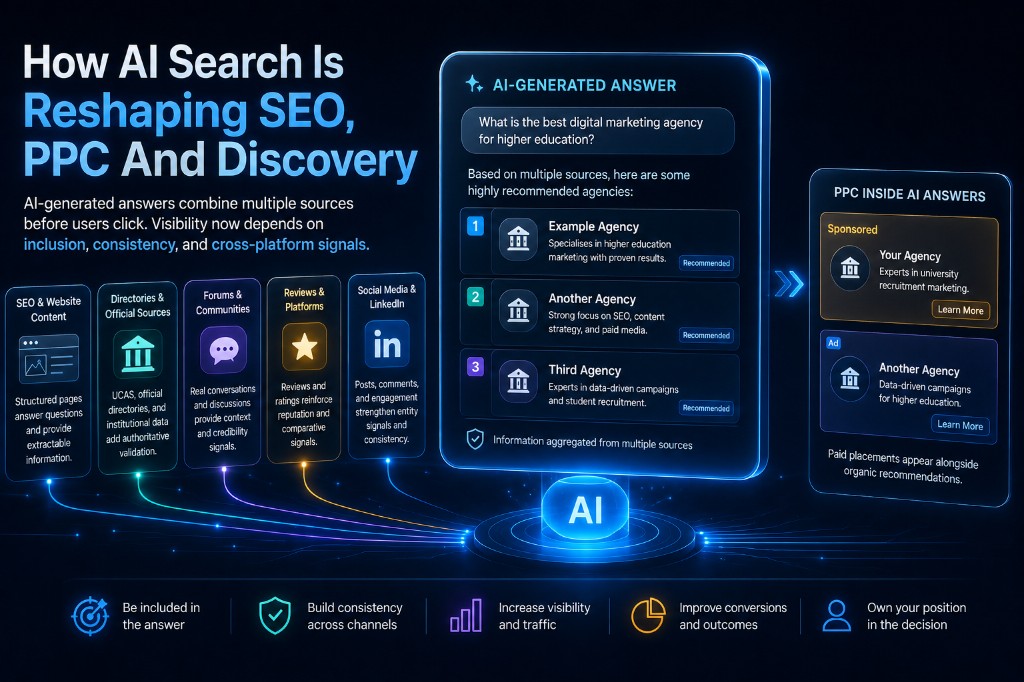
Infographic titled How AI Search Is Reshaping SEO, PPC And Discovery: SEO, directories, forums, reviews, and social sources feed a central AI-generated answer with sponsored PPC placements alongside organic recommendations, emphasising inclusion and cross-channel consistency. Research by Ian Bann, AI Driven SEO Strategist.

AI Search Systems

How AI Search Is Reshaping SEO, PPC And Discovery

AI search compresses discovery into structured shortlists before clicks, so SEO, PPC, and cross-platform consistency increasingly decide inclusion inside AI-generated answers.

2026-05-12 路 8 min read

Related framework: AI Visibility Framework

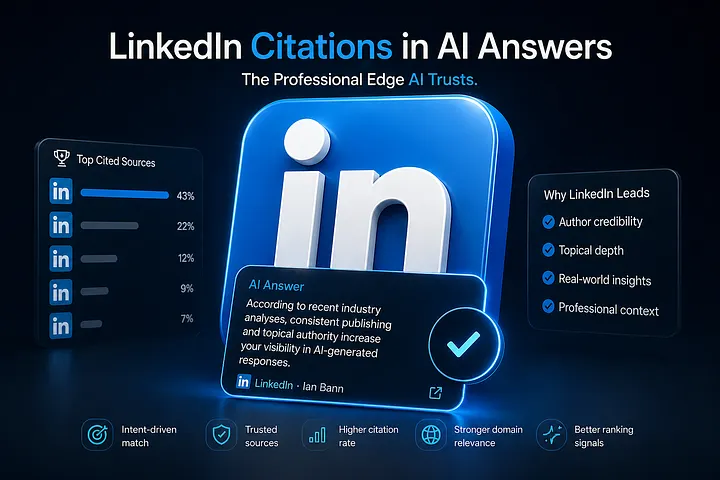
LinkedIn citations in AI answers showing how professional content is selected and reused inside AI-generated responses. Research by Ian Bann, AI Driven SEO Strategist.

AI Citations

Why LinkedIn Content Gets Selected Inside AI-Generated Answers

LinkedIn content appears in AI answers when it is easy to extract, clearly structured, and supported by strong author and topic signals.

2026-05-07 路 8 min read

Related framework: AI Visibility Framework

Dark GA4 analytics dashboard showing AI Assistant traffic separated from referral traffic, representing how AI-generated answer discovery is becoming measurable inside analytics systems. Research by Ian Bann, AI Driven SEO Strategist.

AI Visibility

Why GA4's New AI Assistant Channel Changes How AI Visibility Is Measured

GA4鈥檚 new AI Assistant channel groups AI assistant traffic separately from referrals, so AI-generated answer discovery becomes a measurable acquisition layer inside analytics.

2026-05-15 路 8 min read

Related framework: AI Visibility Framework

Common questions about AI visibility behaviour

Frequenty Asked Questions

Why do high-ranking pages fail to appear in AI answers?

High-ranking pages fail to appear in AI answers when their content is difficult to extract, verify, or align with the exact query intent.

AI systems do not rely on rankings alone. They evaluate whether information can be clearly interpreted and attributed within a generated response. Pages with strong SEO performance can still be ignored if they lack structured answers, consistent terminology, or clear entity signals. Selection depends on how easily content can be used, not just how well it ranks.

What signals influence whether a brand is recommended by AI?

AI systems recommend brands based on clarity, consistency, and confidence signals across multiple sources, not just authority or visibility alone.

Recommendation behaviour requires stronger alignment than citation. AI systems compare sources, validate claims, and prioritise information that reduces ambiguity. Brands that present consistent messaging, clear positioning, and strong corroboration across the web are more likely to be recommended, especially in decision-driven queries where confidence matters more than coverage.

How can you test if your content is being used by AI systems?

You can test AI visibility by running structured prompts and analysing whether your content is cited, summarised, or ignored across different query types.

This involves observing patterns in how AI systems respond to discovery, comparison, and decision queries. By tracking which sources appear and how they are used, you can identify whether your content is being selected. Repeating prompts over time reveals consistency, while gaps indicate structural or clarity issues that prevent inclusion.

Why do AI answers change even when rankings stay stable?

AI answers change because systems continuously re-evaluate sources based on new content, consistency, and how well information aligns with evolving query patterns.

Unlike traditional rankings, AI-generated answers are dynamic. They are influenced by how information is structured, how sources reinforce each other, and how clearly content answers specific questions. Even if rankings remain stable, shifts in clarity, coverage, or competing sources can change which content is selected and how it is presented.

What causes a brand to lose visibility inside AI-generated answers?

Brands lose AI visibility when their content becomes harder to interpret, less consistent, or less aligned with how AI systems extract and validate information.

Loss of visibility is often linked to structural issues, conflicting messaging, or stronger competing sources. AI systems prioritise reliability and clarity, so if confidence drops, selection patterns change. Visibility can decline even without ranking changes, especially when other sources provide clearer or more easily verifiable answers.

If you want to understand how this applies to your own site, the next step is reviewing how your content is being interpreted, or you can visit the contact page to discuss.